
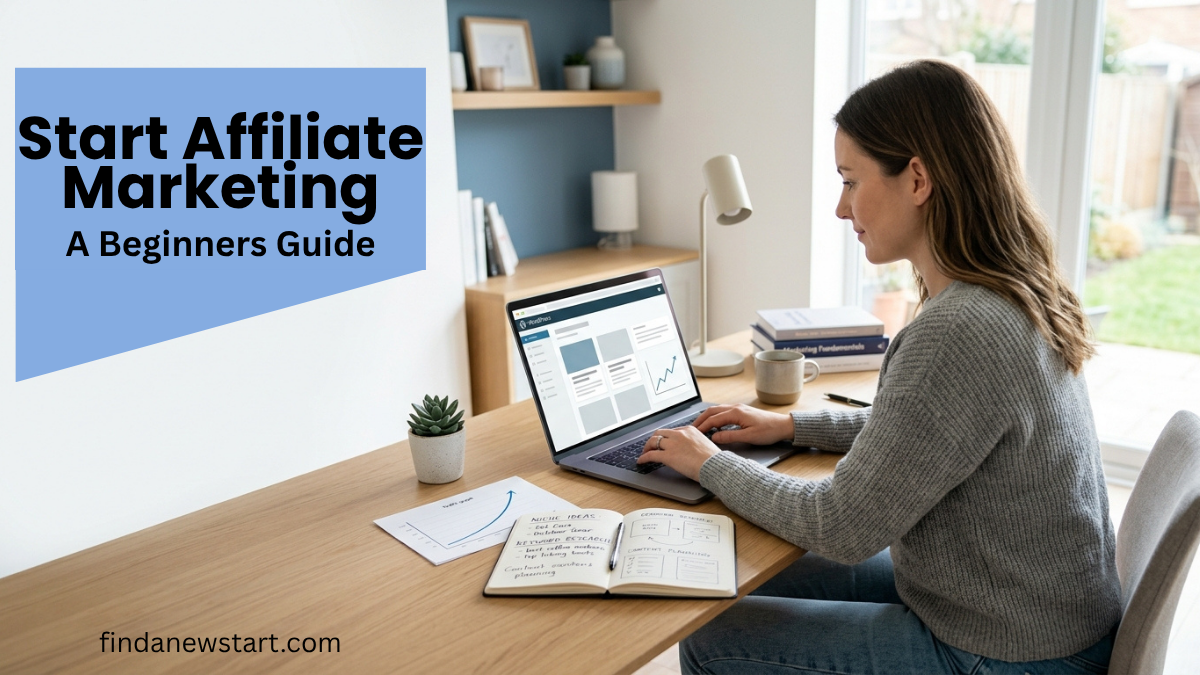
If you’re trying to figure out how to start affiliate marketing with Wealthy Affiliate, you’re probably dealing with information overload.
Pick a niche. Build a website. Find keywords. Write content. Join affiliate programs. Learn SEO.
Oh, and apparently you’re supposed to become a TikTok star somewhere in there.
No thanks.
One reason I like the website-based approach to affiliate marketing is that you can build something you own. You don’t need thousands of followers or a camera pointed at your face every day.
You need a topic, a website, useful content, and people searching for the answers you provide.
That’s where Wealthy Affiliate comes in.
In this guide, I’ll walk you through how you can use Wealthy Affiliate to go from “Where do I even start?” to building your first affiliate website.
What Is Wealthy Affiliate?
Wealthy Affiliate is an online platform designed to teach people how to build an affiliate marketing business.
Instead of buying a course and then being left to figure everything else out, Wealthy Affiliate puts several tools in one place.
You can use it to:
- Learn how affiliate marketing works
- Research and choose a niche
- Build and host a WordPress website
- Learn search engine optimization (SEO)
- Research keywords
- Create website content
- Find affiliate programs
- Get help from other members
- Track your progress as you build your business
The main idea is pretty simple.
You create a website around a specific topic. You publish helpful content people can find through search engines. You recommend useful products or services within that content.
When someone clicks your affiliate link and makes a qualifying purchase, you may earn a commission.
That’s affiliate marketing without needing to spend your day chasing likes and followers.
How Does Wealthy Affiliate Work?
Wealthy Affiliate gives you a structured path to follow instead of trying to piece everything together from random YouTube videos and blog posts.
You start with the training and work through the lessons while building your website.
That’s an important distinction.
You’re not just reading about how to build an affiliate business.
You’re actually building one while you learn.
Your first few steps will normally involve choosing a niche, setting up your website, learning keyword research, and creating your first articles.
From there, you continue adding useful content and working toward getting traffic from Google and other search engines.
Let’s break that process down.
Step 1: Choose Your Affiliate Marketing Niche
Your niche is the main topic of your website.
This is where many beginners get stuck.
They spend weeks trying to find the “perfect” niche.
I don’t think the perfect niche exists.
Instead, look for a subject where people have questions, problems, and products they already spend money on.
For example, instead of creating a website about “pets,” you could focus on:
- Outdoor cat care
- Dog training for beginners
- Aquarium equipment
- Traveling with pets
The same idea works in almost any market.
“Fitness” is broad.
“Home workouts for men over 50” is much more focused.
Wealthy Affiliate’s training can help you understand how to narrow your idea into something you can actually build a website around.
Don’t Choose a Niche Based Only on Money
This is a mistake I see beginners make.
They search for the highest-paying affiliate programs and build their entire business around commission rates.
A 50% commission doesn’t help much if you hate writing about the subject.
Remember that you’ll probably create dozens of articles around your niche.
Choose something you can see yourself sticking with.
You don’t need to be the world’s leading expert.
You do need to be willing to learn.
Step 2: Build Your Affiliate Website
Once you have your niche, you need somewhere to publish your content.
That’s your website.
Wealthy Affiliate includes website-building and hosting tools, which removes one of the more confusing parts for beginners.
You don’t need to become a web developer.
You can build your site using WordPress and customize it as you learn.
Your first website doesn’t need to look like Amazon.
In fact, please don’t try.
Keep it simple.
You mainly need:
- A clean WordPress theme
- Easy navigation
- A homepage
- An About page
- A Contact page
- A Privacy Policy
- An affiliate disclosure
- Your blog content
Your content matters far more than fancy animations and complicated designs.
You can improve the appearance later.
Get the foundation built first.
Step 3: Learn How Keyword Research Works
Once your website exists, you need something to write about.
That’s where keyword research comes in.
A keyword is simply a word or phrase someone types into a search engine.
For example:
best cat shelter for winter
That’s not just a collection of words.
It’s a person looking for something.
If you create a useful article answering that search, your page has a chance to appear when people look for that information.
Wealthy Affiliate teaches keyword research and provides tools to help find potential topics.
You’re looking for phrases that match your niche and have clear search intent.
Beginners should often start with specific questions rather than trying to rank for huge keywords.
Instead of:
affiliate marketing
You might target:
how to start affiliate marketing without social media
The second search tells you much more about what the reader actually wants.
Step 4: Create Helpful Content
This is where the real work starts.
Your website needs useful content that answers the questions people are searching for.
You don’t have to do every part of the writing process alone, either.
AI tools can help you brainstorm topics, create outlines, organize ideas, and speed up your first draft. Wealthy Affiliate also includes AI-powered tools that can help with the content creation process.
But there’s an important difference between using AI to help you write and simply publishing whatever AI gives you.
Your knowledge and judgment still matter.
Use AI as a helper, then add your own voice, examples, opinions, research, and experience. Check facts and make sure the finished article actually answers the reader’s question.
The goal isn’t to publish as many articles as possible.
It’s to publish articles worth finding.
Your content might include:
How-To Guides
Show readers how to accomplish something.
Product Reviews
Help readers decide whether a product is worth buying.
Product Comparisons
Compare two or more products and explain which type of customer each one suits.
Problem-and-Solution Articles
Answer questions people in your niche regularly struggle with.
Buying Guides
Help readers understand what to look for before spending money.
These articles can bring people to your website through search engines.
Some visitors will simply read your answer and leave.
Others may click one of your affiliate links.
That’s where the income side begins.
How Wealthy Affiliate Uses AI to Help Beginners
A Quick Heads-Up
Some links on this page are affiliate links. If you join Wealthy Affiliate through one of my links, I may earn a commission at no extra cost to you.
I only recommend tools and services I believe can help you build your online business. My opinions are always my own.
Ready to See How Wealthy Affiliate Works?
Start exploring the training, website tools, research tools, and AI features you can use to build your first affiliate site.
One thing that makes Wealthy Affiliate more useful for today’s beginner is its use of AI.
Starting an affiliate website involves a lot more than installing WordPress and writing a few product reviews.
You need ideas.
You need keywords.
You need article topics.
And eventually, you need a steady stream of useful content.
That’s a lot when you’re staring at a blank website.
Wealthy Affiliate’s AI tools can help remove some of that friction.
Instead of sitting there wondering what to write, you can use AI-assisted tools to help develop content ideas and move through parts of the creation process faster.
For a beginner, that can be a big help.
AI Doesn’t Have to Replace Your Voice
This is something I think is important.
Using AI doesn’t mean handing over your entire website to a machine.
I prefer to think of AI as an assistant.
Let it help with the repetitive parts.
Then you take over.
Add your experience. Change things you disagree with. Include examples. Check facts. Rewrite sections so they sound like you.
That’s especially important with affiliate content.
If you’re recommending a product, your reader deserves more than a generic description anyone could find on the manufacturer’s website.
They want to know things like:
- Who is this product really for?
- What are its drawbacks?
- Is there a better choice for certain people?
- Is it worth the price?
- What should someone know before buying it?
Those are the details that make your content useful.
AI Can Make Starting Less Intimidating
I also think AI has removed one of the biggest barriers to starting an affiliate website:
The blank page.
You might have a great niche idea but have no clue how to turn it into 50 useful articles.
AI can help you get moving.
It can help you brainstorm, organize ideas, and create a starting point.
You still have to build the business.
But you don’t necessarily have to build every piece from scratch.
For someone starting their first affiliate site, that can make the whole process feel much more manageable.
Updated: Is Wealthy Affiliate Worth It for Beginners?
I think the biggest value for a beginner is having a path.
Affiliate marketing isn’t especially difficult to understand.
The problem is that there are so many pieces.
You need to understand niches, websites, keywords, SEO, content, affiliate programs, links, disclosures, traffic, and conversions.
Now AI is becoming part of that process as well.
Trying to learn all of these things from unrelated sources can get messy fast.
Wealthy Affiliate brings much of the process together by combining training, website tools, research tools, hosting, AI-assisted tools, and a community in one place.
That doesn’t mean the platform does all the work for you.
You’ll still need to make decisions, create useful content, learn your niche, and build your website over time.
But you don’t have to figure out every single step by yourself.
The platform gives you the toolbox—and AI gives you a few power tools. You still have to build the house.
Step 5: Find Affiliate Programs
You don’t need an affiliate program before publishing your first article.
Build the site first.
Once you have some useful content, you can start looking for companies with affiliate programs related to your niche.
There are several ways to find them.
You can search for:
[brand name] affiliate program
or:
[your niche] affiliate programs
You can also look at affiliate networks that manage programs for many different companies.
Before joining, check things such as:
- Commission rate
- Cookie duration
- Payment terms
- Product quality
- Brand reputation
- Affiliate rules
Don’t choose products just because they pay the biggest commission.
Recommend things that make sense for your reader.
Trust is worth far more than squeezing an extra few dollars from one click.
Step 6: Add Affiliate Links to Your Content
After you’re accepted into an affiliate program, you’ll receive special tracking links.
These links tell the merchant that you referred the customer.
You can add them naturally to relevant articles.
For example, imagine you wrote:
10 Things You Need for Your First Home Office
You might recommend a desk, office chair, monitor, keyboard, or lighting.
Each recommendation could include an affiliate link.
If a reader clicks one of those links and makes a qualifying purchase, you may receive a commission.
Don’t turn every paragraph into an affiliate link.
Readers came for help first.
Give them that help.
The affiliate links should support the content, not become the content.
And always clearly disclose when your content contains affiliate links.
Step 7: Get Traffic Without Becoming a Social Media Creator
This is one of the biggest reasons I’m interested in this approach.
You can build an affiliate marketing business without making social media your entire life.
That doesn’t mean social media is bad.
Pinterest, Facebook, YouTube, and other platforms can all send visitors to your website.
But they don’t have to be the foundation of your business.
Your main goal can be creating content that gets found when people search for answers.
That means learning SEO.
SEO stands for search engine optimization.
At its core, SEO means making it easy for search engines and readers to understand what your page is about.
That includes things like:
- Choosing useful keywords
- Matching search intent
- Writing clear titles
- Organizing articles properly
- Linking related articles together
- Creating genuinely helpful content
- Building a trustworthy website
SEO takes time.
You probably won’t publish three articles on Monday and quit your job Friday.
Wouldn’t that be nice?
Think of your website as a growing library.
Every useful article gives people another way to discover you.
Step 8: Keep Building
This may be the least exciting step.
It’s also one of the most important.
Keep going.
Affiliate marketing usually takes time.
Your first articles may get very little traffic.
Some might never rank well.
Others may surprise you.
As you publish more content, you’ll learn what your readers search for and which topics bring visitors.
That’s when your website starts becoming more than an experiment.
It becomes an asset.
The people who give affiliate marketing a fair chance are usually the ones willing to learn, adjust, and keep publishing.
Can You Really Make Money With Wealthy Affiliate?
Wealthy Affiliate can give you training, tools, hosting, and a community.
It can’t guarantee you’ll make money.
That’s an important distinction.
Buying a membership doesn’t create an affiliate business.
You still have to choose a niche, build the site, create content, learn SEO, find affiliate programs, and stick with it long enough to see what works.
Income can vary greatly.
Some people may never make a profit.
Others can build websites that produce regular affiliate commissions.
I would be skeptical of anyone promising you a certain income within a certain number of days.
Affiliate marketing doesn’t work like that.
Wealthy Affiliate should be viewed as a platform for learning and building—not a push-button income system.
Who Is Wealthy Affiliate Best For?
I think Wealthy Affiliate makes the most sense for someone who wants guidance while building their first affiliate website.
It may be worth considering if you:
- Are completely new to affiliate marketing
- Want to build a niche website
- Don’t know how to set up WordPress
- Want to learn SEO
- Prefer step-by-step training
- Want tools and training in one place
- Don’t want your entire business tied to social media
It can also help if you’ve tried affiliate marketing before but never had a clear plan.
Sometimes the problem isn’t effort.
It’s having 47 browser tabs open and 47 people telling you different things.
Who Might Not Like Wealthy Affiliate?
Wealthy Affiliate won’t be right for everyone.
If you’re already an experienced SEO, website builder, and affiliate marketer, you may not need beginner-focused training.
It’s also not a good fit if you’re looking for instant income.
You’re building a website.
That takes work.
You’ll need to research topics, write articles, learn from mistakes, and wait for traffic to grow.
If you’re looking for a system where you pay money today and automatically collect commissions tomorrow, this isn’t it.
That’s probably a good thing.
Free vs. Paid Wealthy Affiliate Memberships
Wealthy Affiliate has offered different membership levels and features over time.
Before choosing a plan, check Wealthy Affiliate’s current pricing page so you know exactly what’s included.
Pay attention to:
- Training access
- Website hosting
- Research tools
- AI or content tools
- Support
- Number of websites allowed
- Billing period
- Renewal price
Don’t automatically choose the most expensive option.
Start with the level that gives you what you actually need.
You can always upgrade later if your business grows and the extra tools make sense.
Is Wealthy Affiliate Worth It for Beginners?
I think the biggest value for a beginner is having a path.
Affiliate marketing isn’t especially difficult to understand.
The problem is that there are so many pieces.
You need to understand niches, websites, keywords, SEO, content, affiliate programs, links, disclosures, traffic, and conversions.
Trying to learn all of that from unrelated sources can get messy fast.
Wealthy Affiliate brings much of that process together.
But remember:
The platform is the toolbox. You still have to build the house.
How I Would Start With Wealthy Affiliate Today
If I were starting from scratch, I wouldn’t worry about making money during my first few days.
I’d focus on getting the foundation right.
My first goals would be:
- Complete the beginner training.
- Pick one focused niche.
- Build one simple website.
- Learn basic keyword research.
- Find 20 potential article ideas.
- Publish my first five useful articles.
- Set up my essential website pages.
- Learn basic SEO.
- Join relevant affiliate programs when appropriate.
- Keep publishing and improving.
Notice what’s missing?
Obsessing over logos.
Changing WordPress themes twelve times.
Checking traffic every 20 minutes.
Trying six different business models at once.
I’ve learned that those things can feel productive without actually moving the business forward.
Build first.
Polish later.
Your Next Step
If affiliate marketing sounds like something you’d like to try, don’t worry about learning everything before you begin.
Start with the basics.
Choose your niche.
Build your website.
Learn what your audience is searching for.
Create useful content that answers those searches.
Then find good products and services that naturally fit that content.
Wealthy Affiliate can provide the training and tools to help you work through those steps.
It isn’t a shortcut.
It isn’t guaranteed income.
And it won’t build the business for you.
But if you’re staring at affiliate marketing thinking, “Okay…where the heck do I actually start?”, having a clear path can make the whole thing much easier.
That’s exactly what a good Start Here resource should do.
Give you somewhere to start—and show you where to go next.